Architecture / E-Commerce / ERP & CRM
Volleer
A rebuilt website with native e-commerce, an AI-powered CRM, and a centralized supplier ERP — four components deployed to remove every manual bottleneck from Volleer's commercial and operational workflow.

The Challenge
The challenge was to deliver a comprehensive digital transformation for an architecture agency operating on reputation and referral — where every client interaction, proposal, and supplier relationship reflected the quality of the brand. Manual processes were holding back both the commercial machine and the team's ability to focus on what they did best.
Debrief
Architecture agencies run on reputation and responsiveness. Volleer had both — but was losing hours to manual processes that undermined neither. Proposals were written from scratch for every client. Supplier files sat scattered across inboxes. The website gave visitors no mechanism to act on what they saw — no way to configure a service, request a quote, or make a purchase without picking up the phone.
The engagement opened with a detailed workflow audit. Every manual touchpoint was mapped, every friction point identified. From that baseline, a four-component system was scoped to address each one with precision.
Business Goals
The commercial objective was to turn the website from a passive portfolio into an active acquisition channel — one where a client could browse services, configure requirements, and pay without any human in the loop. On the internal side, the targets were equally concrete: eliminate proposal drafting time, centralize supplier management, and give the sales team an AI assistant capable of handling the first wave of client queries directly inside the CRM.
Two outcomes defined success: expand the revenue surface, and compress the manual workload.
Solution Overview
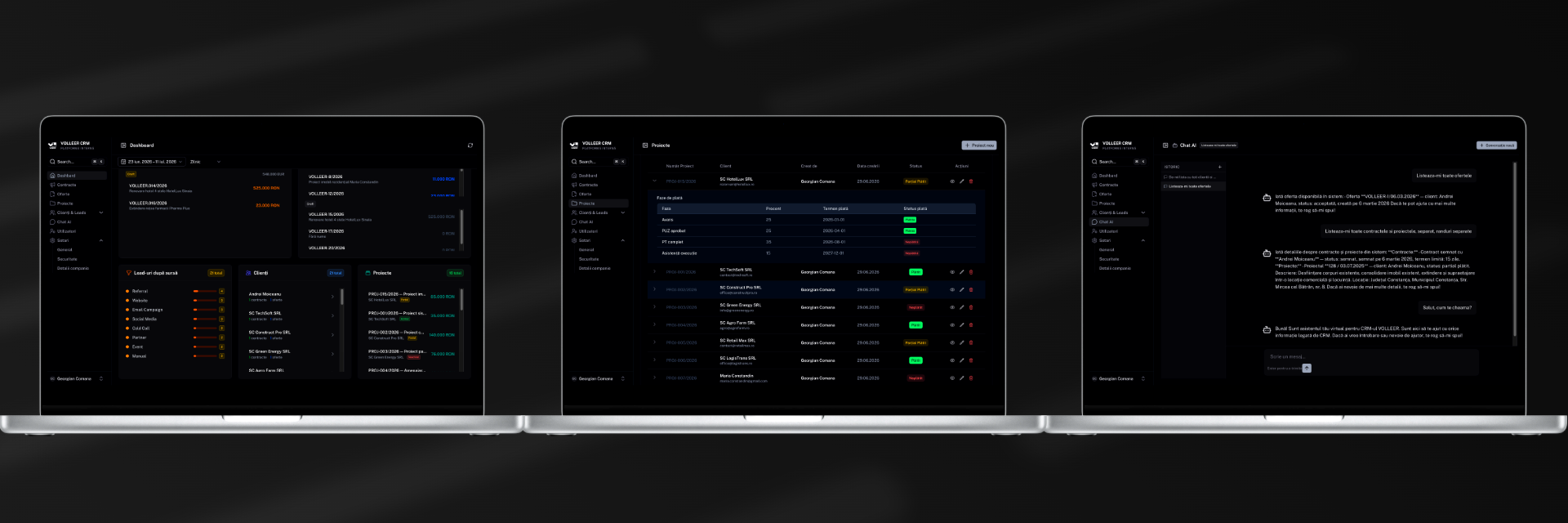
Three integrated platforms were deployed alongside a rebuilt website. The CRM manages the full commercial pipeline — lead capture, client management, offer generation, and contract execution — with an AI assistant embedded directly in the interface. Connected to live CRM data and website content, it handles client queries in real time without pulling a team member in. The ERP handles the supplier side: contacts, active contracts, and all associated documentation in a structured, searchable environment.
The website was rebuilt to Volleer's exact brand standards — typography, palette, and layout — with a native e-commerce module integrated into it. Clients can browse, configure, and purchase services via Stripe without leaving the site. Every component was scoped in direct sessions with the Volleer team, ensuring each tool solved a real operational problem.
- Nuxt
- Vue
- Tailwind CSS
- Supabase
- Stripe
- OpenAI
Key Technical Features
The CRM's AI assistant connects to a curated context window — live pipeline data and website content — giving it what it needs to respond accurately without exposing data outside its authorized scope. Document generation is template-driven throughout: offer and contract structures are pre-built, with variable fields populated automatically from project data. The e-commerce module handles the full service acquisition flow — selection, configuration, and Stripe-secured checkout — entirely within the website. All internal platforms sit behind HTTPS with mandatory authentication; the e-commerce layer inherits Stripe's payment security standards by design.
- AI-powered CRM assistant reading live pipeline and website data via OpenAI to handle client queries in real time
- Native e-commerce module with full Stripe payment processing built directly into the website
- Automated offer & contract generation from Volleer's own pre-built service templates
- Centralized supplier ERP with full document and contract management
- Brand-accurate website rebuild designed as an active revenue channel, not a static portfolio
Development Environment
Built on the same stack as the wider business2point delivery practice: Nuxt, Vue, and Tailwind CSS for the frontend; Supabase for authentication, database, and file storage. Stripe powers payment processing across the e-commerce layer. The AI assistant runs via the OpenAI API with custom context management to scope responses to authorized data sources only. JavaScript and CSS handled precision interface requirements across all four surfaces.
Performance & Security Optimizations
The AI assistant's context is tightly controlled by design — it can only surface information from explicitly authorized sources. Client records, internal pricing, and documents outside its defined scope are inaccessible to it, ensuring confidentiality holds even as usage scales.
Payment flows run entirely through Stripe's infrastructure — no sensitive financial data ever passes through or is stored on Volleer's own servers. Document generation keeps processing overhead flat regardless of request volume: templates are pre-built, only variable fields are populated, no file is ever rebuilt from scratch.
Development Process
Delivered in sprint cycles with a live review at each milestone. The AI integration required the most iteration — defining precisely what the assistant should know, how it should respond, and where its limits should sit. Each boundary decision was reviewed and signed off by the Volleer team before going live. The e-commerce module was tested against real service configurations before deployment, ensuring the checkout flow matched the actual complexity of Volleer's offering.
Results & Impact
Volleer's website now closes deals without a salesperson in the loop. The CRM's AI assistant handles the first wave of client queries, proposal generation takes seconds, and supplier management no longer depends on scattered inboxes. Four components, one coherent system — built for an architecture agency that was already excellent and needed the infrastructure to match.
— Ready to build?